Do your practice with devotion, without attachment to the practice or the poses. Free from desire.
Practicing for over a decade is a long conversation with yourself. Over the years, I’ve found that there is a particular kind of clarity that comes from practicing something long enough that the structure itself becomes the teacher.
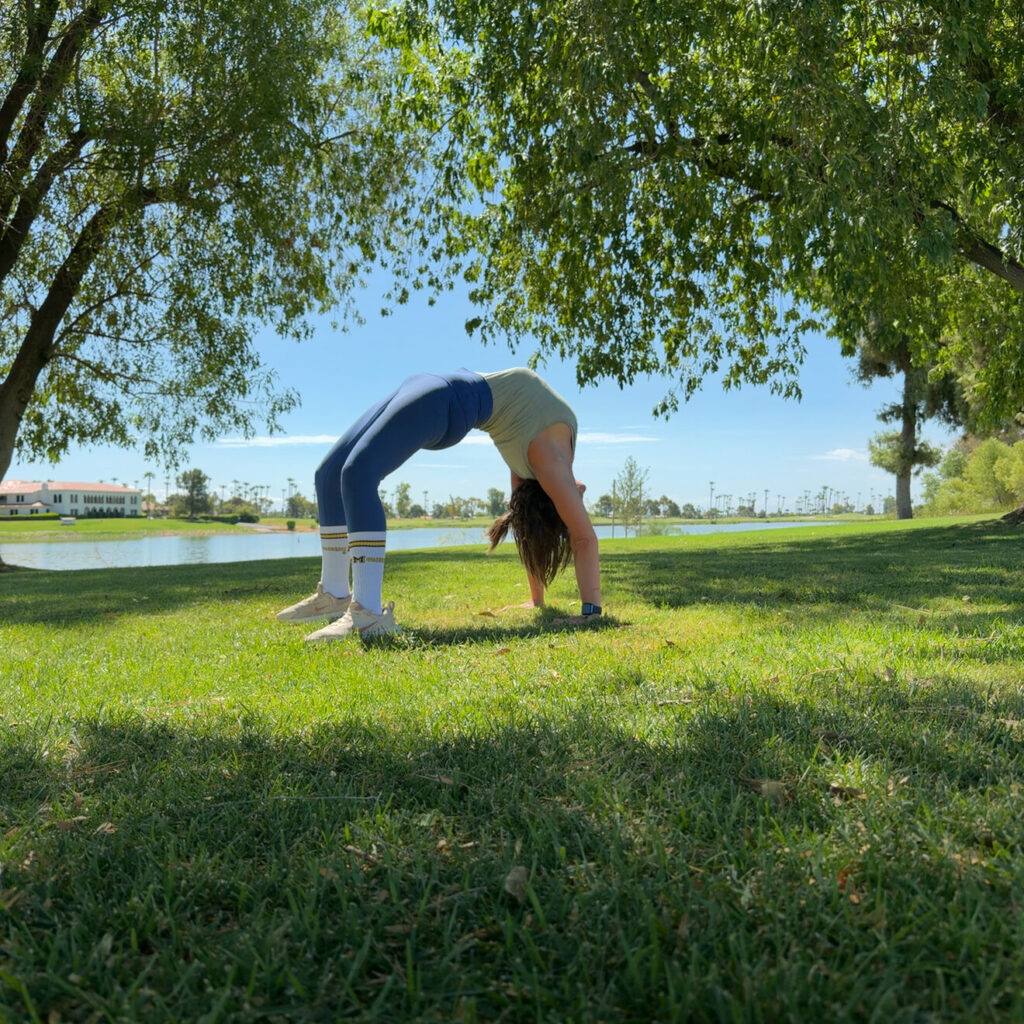
I’ve always appreciated the guidelines of Ashtanga yoga: you show up to your mat six days a week to practice the same poses in the same sequence, progressively building as you go. This creates the stability required for honest inner inquiry. Just like in my functional strength workouts, this fixed outer form isn’t rigidity, it’s scaffolding.
Recognition
My yoga journey began in the spring of 2013 with a Yin class. I remember walking out of that room completely in awe of how quiet and peaceful my mind had been for 60 solid minutes, something I hadn’t experienced in months, if ever. That single hour instantly had me seeking out more, which led me to a 200-hour YTT program in Scottsdale.
I took my very first Ashtanga class on July 4, 2013, and instantly knew I had found my forever practice. Looking back, that wasn’t just nostalgia; it was recognition. The practice recognized me, and I recognized it.
Intelligence in Rest
There is a distinct rhythm to Ashtanga: we take rest on new moon and full moon days. And for women, it is suggested from an Ayurvedic perspective to rest the first one to three days of our “ladies holiday.”
Speaking in the most simplistic way, my understanding is that menstruation is already the body cleansing itself. To force the rigorous cleansing of Ashtanga on top of that is simply extreme. It’s not about fragility or exclusion, it’s about intelligence. The body is already doing the work. Rest is not an absence from the practice; it is a vital part of the sequence.
The Container and the Check-In
This delicate balance of effort and intentional rest shapes the entire framework of the Ashtanga method. The expectation to show up on the remaining six days, no matter what, forms the rest of that container. But inside that container, you are constantly listening: to your breath, to your sleep, to your digestion, to the quality of your mind. You can’t fake your way through a practice you show up to six days a week for twelve years. The physical body holds the absolute truth of where you are, and the mind inevitably reveals itself.
When I wake up, regardless of how I feel or what else is on my plate, yoga is just part of my day. It serves as a daily check-in. Because I haven’t practiced in a studio or with a teacher for years, setting up a time-lapse to record my session is my way of holding myself accountable for showing up at a consistent time each morning. Ultimately, it is the practice itself that roots me in the present moment.
It also teaches profound self-compassion (ahimsa). Since I started practicing, I’ve navigated a complex history of injuries: ribs that are prone to fracturing, chronic ankle issues, a torn ACL, and lower back problems where my L5 and S1 basically sit on top of one another without any cushion, pinching things that should’t be pinched.
When I broke my right scaphoid three times and had surgery to put a screw it, only to have it result in a nonunion with a protruding screw, I had to deeply re-evaluate how I approach my time on the mat. Mentally, my practice is essential, so I’ve adjusted by using yoga blocks under my hands to alleviate some of the pressure. While using props isn’t a traditional way of practicing Ashtanga, it’ s my way of honoring ahimsa and making sure my practice is sustainable for the duration of my life.
A Laboratory for Life
Ultimately, the physical asana practice is just one of the eight limbs (ashta anga) of yoga. The physical practice is the entry point, but the real draw, the thing that keeps you showing up through injury, exhaustion, heartbreak, and ordinary Tuesday mornings, is that the mat becomes a laboratory for the rest of your life.
The discipline of showing up six days a week mimics the natural fluctuations of the real world. Finding equanimity (sthira sukham asanam) in increasingly difficult postures eventually becomes finding equanimity in increasingly difficult conversations, losses, transitions, and uncertainties. The breath doesn’t change. The gaze (drishti) doesn’t waver. You simply show up.
This is what I call “Mysore magic.” It is the true alchemy of devotion (bhakti), discipline (tapas), and non-attachment (vairagya). You do the work, but you don’t grip the outcome.
And that is exactly where freedom lives.