In my last post, I wrote about the six-day-a-week container of my practice, and I ended by naming something I’ve been circling all series: asana is only one limb of eight. I called the mat a laboratory and closed on the word freedom. So this week I want to open that up. For years I treated the Eight Limbs like a staircase — poses first, the subtler parts later. It took years to see I had it backwards. The limbs are the whole architecture. The poses are simply the door.
What the Name Actually Says
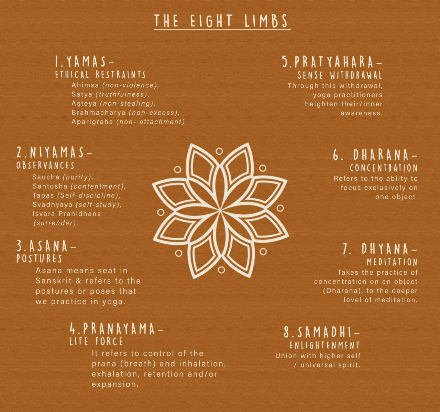
I mentioned ashta anga in passing last time, and it deserves more than that. Ashta means eight, anga means limb — Ashtanga is, quite literally, “eight-limbed.” The name of the system describes the system: a path laid out by the sage Patanjali, the physical practice one branch among many growing from the same trunk.
And here is the part that surprises people: although Patanjali lists the yamas (ethical restraints) and niyamas (personal observances) first, the way it was taught to me starts students with asana. That ordering is practical. The body is the most accessible way in — the postures settle the nervous system and give the ethics somewhere to land. Steadiness and honesty grow together from the first sun salutation. An unsteady mind can’t keep a vow. So we begin with the body.
Learning to Teach Myself
The way the physical limb is traditionally taught made all of this possible for me. Mysore-style practice is self-paced: you memorize the sequence and move at the rhythm of your own breath, with no teacher’s voice holding the room together. You carry the practice inside yourself. Some mornings that means standing at the top of my mat deciding when the next inhale begins — and again, breath after breath, for the whole practice. Nobody calls it pranayama or dharana in the moment, but that is what it is: moving on your own breath, holding your own focus with nobody there to hold it for you. The format trains independence from day one; it’s why leaving the studio never meant abandoning the practice.
The Limbs Are Already Here
What I’ve come to love is how early the other limbs show up. Take the yamas. You’ve already read about my blocks — that was ahimsa (non-harming), and I won’t retell it here. But there is another yama I practice every morning: satya (truthfulness). Before I move, I take an honest inventory. What can this body do today — this one, the one that woke up this morning? Last week it meant backing out of a deep forward fold my ego had already committed to, and sulked for two breaths before letting go. Satya is refusing to lie to myself on the mat; some mornings that refusal is the hardest part of the practice.
Or take pranayama (breath control). Nobody waits until some advanced stage to start breathing. From the first sun salutation, the vinyasa system ties every movement to an Ujjayi breath — a soft rasp in the back of the throat, the sound that tells me I’ve arrived on the mat. The breath paces the movement and builds the heat; over a full practice, separate postures become one continuous act of breathing. In this house, pranayama is breath number one.
And pratyahara (withdrawal of the senses)? Anyone who has practiced outside knows it in the body before they learn the Sanskrit. The wind, the birds, a dog barking two yards over — and still, the attention stays on the breath and the drishti. The world stays as loud as it was. Somewhere in the middle, you stop following every sound.
Where It All Points
The final three limbs are where the practice gathers itself. Dharana (concentration) is holding the mind on one point. Dhyana (meditation) is when that holding stops requiring effort and becomes continuous. And samadhi — I want to be precise, because pop culture has flattened it into “a state of profound peace.” It is not that. Samadhi is absorption. Complete integration. The illusion of separation dissolves; no meditator is left standing apart from the meditation. Peace may come with it, but that peace is incidental — a side effect of the absorption
The Wider Container
The Eight Limbs describe the inner life; Ayurveda is the daily container that holds all eight. If you’ve been reading along, you’ve already seen it at work — the moon days and the rest, the rhythm that holds the practice without squeezing it. They are eight ways of describing one integrated life, and every one of them was present in my first clumsy sun salutation, years before I had the words.
The door was never separate from the house.