For years, I’ve used Wikipedia strictly as a consumer of media. It’s arguably the most important collaborative effort on the internet, yet the inner workings of how its pages are maintained always felt like a mystery. After spending some time learning about how the site actually functions behind the scenes, I finally decided to see what it would take to contribute to a page rather than just read one.
As an Ashtanga yoga practitioner, I gravitated toward the Wikipedia pages surrounding the method. While reviewing them, I noticed a gap in the recent historical timeline: nowhere did the articles explain what happened to the lineage after founder K. Pattabhi Jois’s death in 2009. His grandson, R. Sharath Jois, had succeeded him as lineage holder (paramaguru) — first directing the K. Pattabhi Jois Ashtanga Yoga Institute, then establishing his own Sharath Yoga Centre in Mysuru — until his own passing in November 2024. That entire chapter of the tradition’s history was missing.
I drafted a concise sentence capturing that succession, backed by two reliable citations: The New York Times and The Hindu. Wikipedia’s foundation rests on verifiable, third-party sources, so I knew my references had to be airtight. Following protocol, I went to the “Talk” tab of the Mysore style article to propose the change.
Hitting submit was nerve-wracking — waiting for feedback from seasoned editors is intimidating. But the Wikipedia community moves fast. Within minutes, a veteran editor named Chiswick Chap replied with a blunt but useful correction: my update was “not relevant here,” and he pointed me to the Tradition section of the main Ashtanga (vinyasa) yoga page instead.
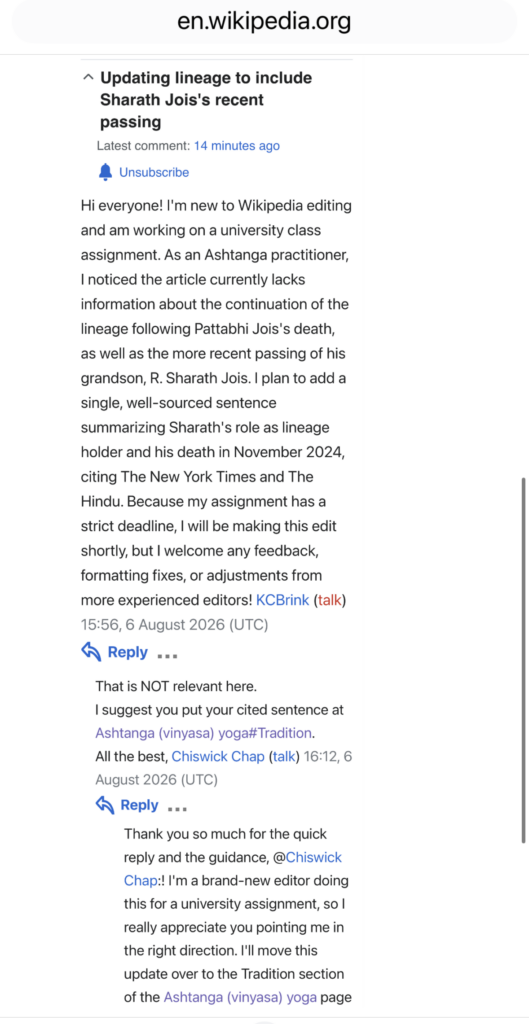
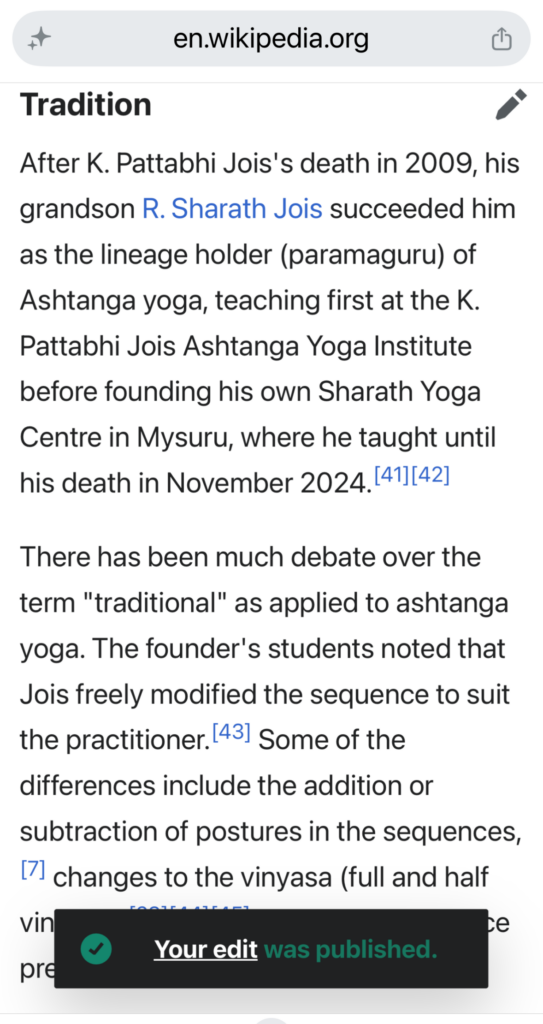
My first reaction was disappointment that I hadn’t picked the right page. That quickly turned into gratitude, and honestly excitement, at getting direct feedback from an experienced editor. I thanked him and made my fully cited edit exactly where he suggested.
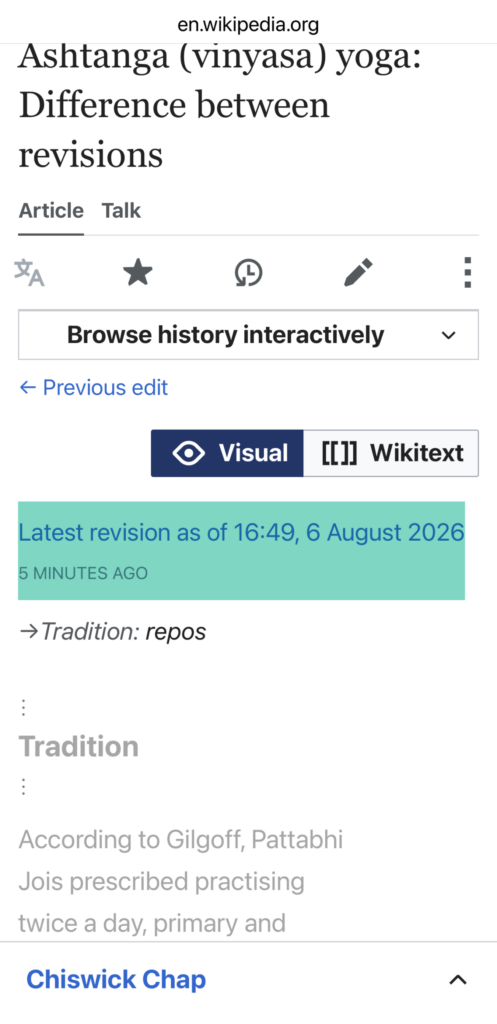
Checking the revision history, I could see my contribution — username, timestamp, edit summary — recorded in the site’s permanent public log. The story didn’t end there. Nineteen minutes after I published, Chiswick Chap returned and repositioned my sentence within the section where he felt it fit best. My words weren’t deleted — they were adopted and improved. That taught me more than anything else: on Wikipedia, no one owns the content. Once you publish, it belongs to the community, and the community tends it.
That evening, I did what I always do: I went back to recheck my work. Re-reading the sentence, I saw that my citations covered the succession and Sharath Jois’s death, but none specifically verified that he had founded his own centre. On Wikipedia, an unverified detail is a vulnerable one. So I added a third citation, from the Economic Times, documenting the centre’s founding directly.
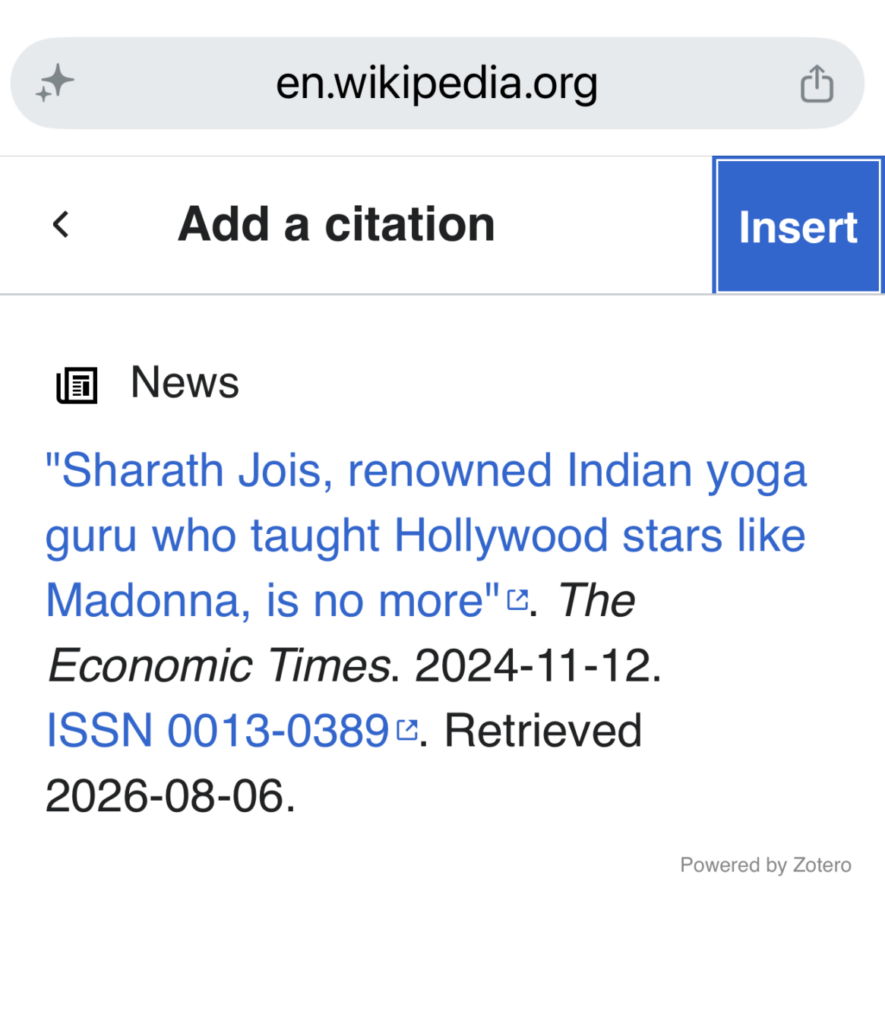
That should have been the end of it, but a final read-through turned up an embarrassing mistake: my original New York Times and Hindu citations pointed to each outlet’s homepage rather than the actual articles. So I went back in and made two more small edits, swapping in the correct URLs for both. It was a humbling reminder that “cited” and “correctly cited” aren’t the same thing — and that on Wikipedia, fixing your own sloppy work is just as much a part of the process as the original edit.
This experience shifted how I see Wikipedia. It shattered the idea that the site is static or unmonitored. Behind the scenes, it’s a fiercely curated ecosystem where editors watch, organize, and enforce accuracy — sometimes within minutes. And it runs in both directions: the community refined my contribution, and I went back to refine it, twice more, myself.
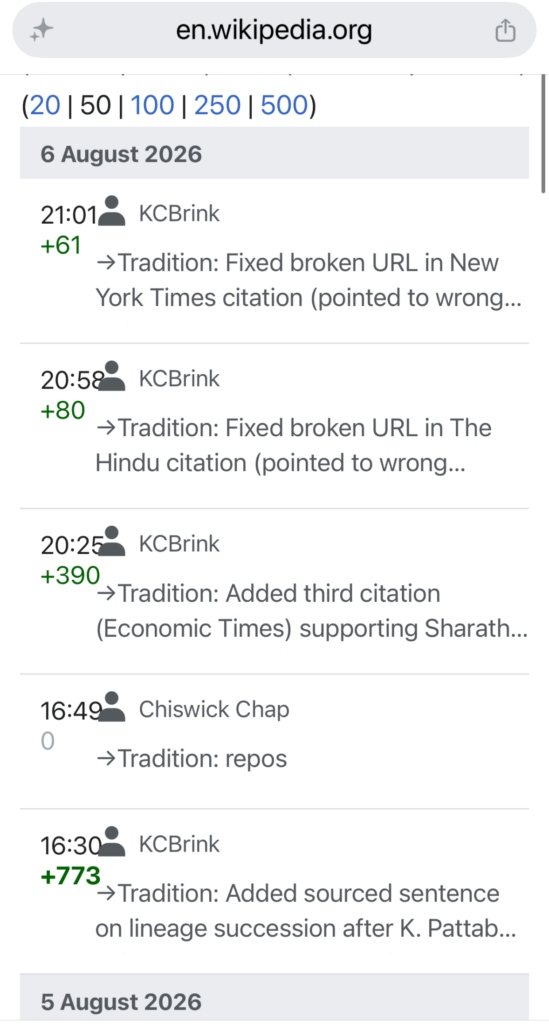
The revision history tells the whole story in five lines: my original edit at 16:30, Chiswick Chap’s refinement at 16:49, my added citation at 20:25, and two more small fixes at 20:58 and 21:01 as I cleaned up my own sourcing. One sentence, tended by two people across a single evening. If you open the Ashtanga (vinyasa) yoga article today and scroll to the Tradition section, that sentence is still there — citations and all. It turns out Wikipedia’s front page and its backstage are separated by a single tab — and now I’ve been on both sides of it.