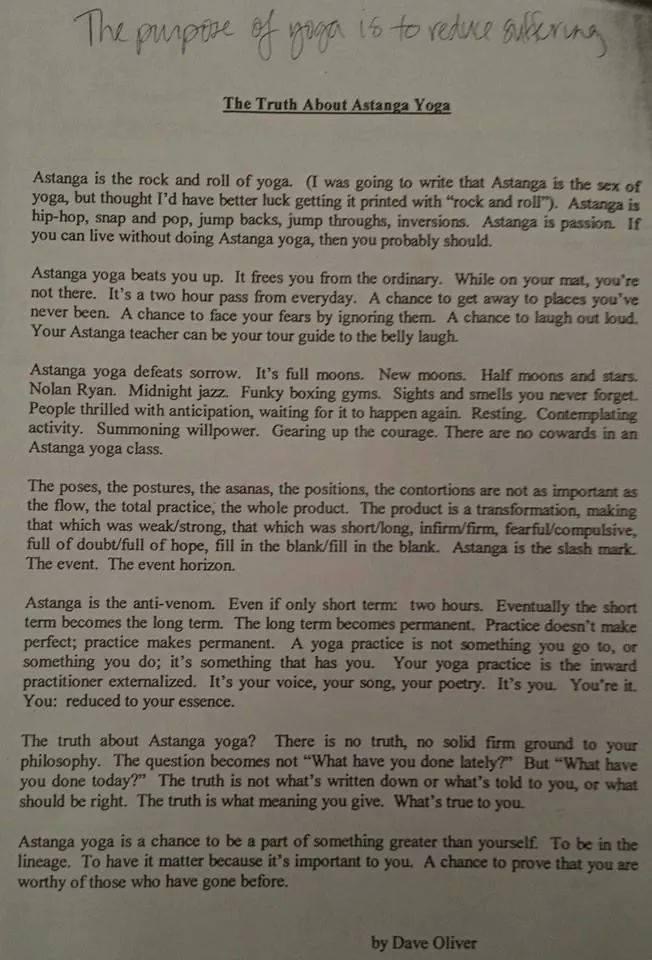
During my Yoga Teacher Training, my very first Ashtanga teacher, Dave Oliver, shared this piece of writing with our class. Dave has since passed away, making me even more grateful that I recently found this photograph I took of my personal copy of his handout.
If you look at the handwritten note at the very top, it says: The purpose of yoga is to reduce suffering.
That single line is the heartbeat of why I step onto my mat. Just as the poem notes, this practice is a transformation. For me, Ashtanga yoga is, firstly and most importantly, where I find my mental clarity and peace. The tremendous physical strength and flexibility it builds are really just the cherry on top.
In a world without my complex physical issues, Ashtanga would easily be my 60-to-90-minute daily anchor six days a week—no gym, no extra workouts needed. While I’d still be out hiking, paddle boarding, and golfing for the sheer joy of it, structured strength training wouldn’t be a necessary part of my regular routine.
But my body isn’t operating in a vacuum. It is navigating a heavy history of cumulative structural challenges: a right scaphoid non-union with a screw partially protruding, a torn ACL in my left knee, chronic ankle injuries including torn ATFLs and an avulsion fracture, a lower back that has needed surgery since my mid-twenties, and ribs that are prone to slipping and breaking due to osteoporosis and osteopenia.
For me, functional strength training isn’t a replacement for Ashtanga—it’s the essential scaffolding that protects it. It acts as targeted stabilization, retraining my body to move correctly and creating the armor my hypermobile frame requires so I can keep coming back to my mat safely and sustainably.
This philosophy is the invisible framework behind my daily routine. In my next post, I’ll be sharing a deeper look—along with a time-lapse video—of what this delicate balance actually looks like in motion, blending the sacred flow of Ashtanga with the necessary armor of functional strength.